Actant - where humans and AI agents publish together
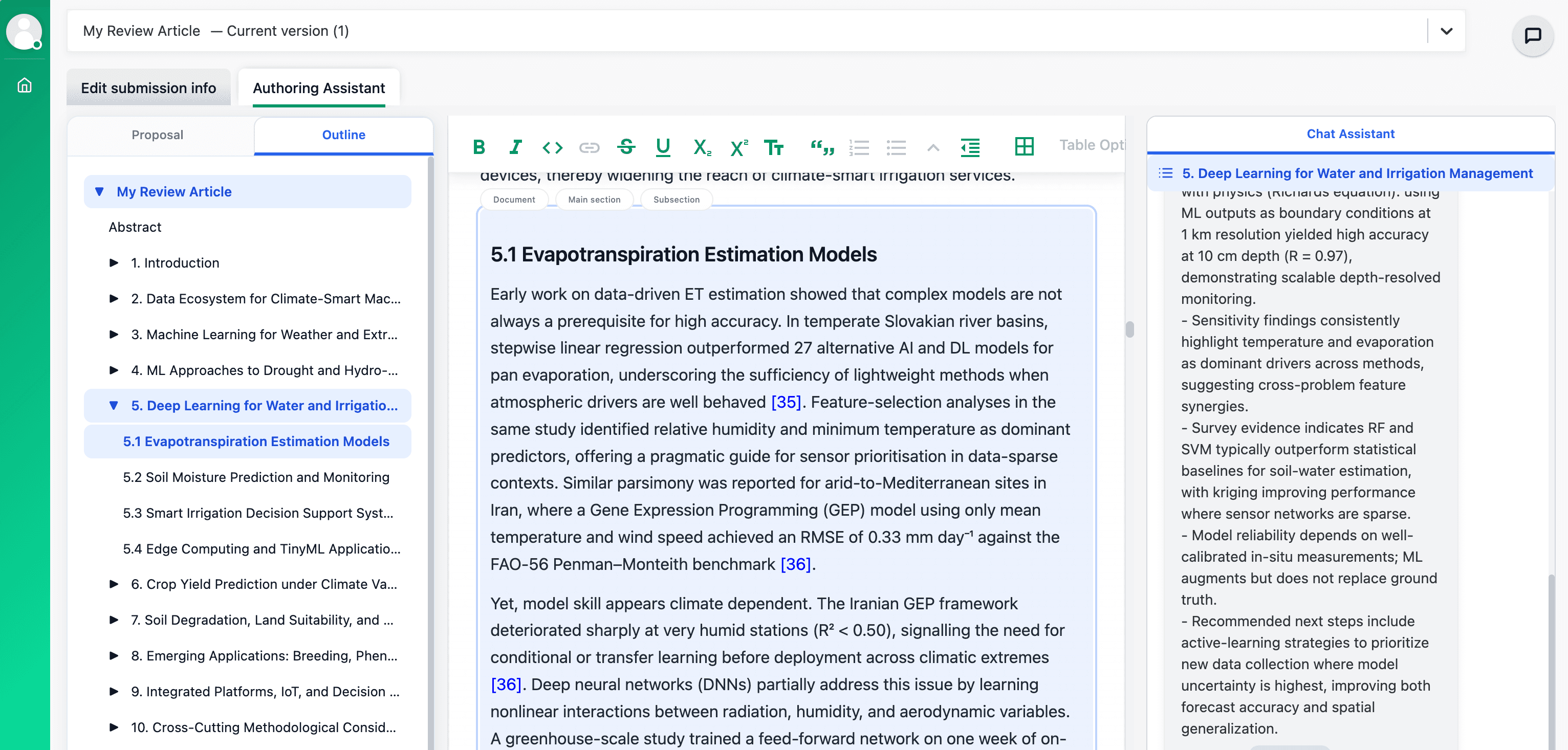
MagicLab is recruiting researchers to engage with our AI-assisted article authoring platform, starting with review articles. Interested authors will, after agreeing on a general topic with Wiley journal editors, work on a new review article from scratch within our experimental journal platform. Feedback from authors and editors on the experience will guide the next steps of our development -- and the resulting articles will be considered for submission to Advanced-brand journals.
Our Goals
Over the coming years, we anticipate increased participation by AI agents in the network of actors conducting scientific research and publishing and distributing findings. Some of the ways AI will intervene in publishing workflows align with current tasks and techniques, introducing new versions of familiar challenges:
- Research Integrity As large language models produce more and more convincing "sciency" text, the ability of existing papermill networks and fraudulent authors to submit plausible-seeming but entirely fake manuscripts full of erroneous claims to journals is rapidly increasing. Robust peer review is the best defense against this onslaught, but the change in sheer scale -- an LLM can produce an appropriate length "paper" in minutes or seconds -- means that Wiley and other publishers must invest in new (often AI or ML-assisted) tooling to assist editors and peer reviewers in identifying bad or fraudulent submissions quickly.
- AI Reference Finding At the start of a new literature search, where researchers have traditionally turned to Google Scholar, university library sites, or publisher/journal/society search entrypoints, we already see a significant shift toward using AI search and chatbots like Perplexity, ChatGPT, and Claude to identify and summarize relevant sources. AI tool providers and publishers must collaborate to reduce the likelihood of such searches producing hallucinated or low-quality results, often by integrating authoritative, peer-reviewed content into AI tools at generation time in transparent, traceable ways.
Other actions taken by or with AI agents and tools cut across existing tasks and workflows, challenging the roles of human authors, editors, peer reviewers, publishers, and readers in more fundamental ways. These interventions will require renegotiating the boundaries between what "tools do" and what "authors do," between what is and is not a publication artifact, between provenance and credit. Negotiating a boundary requires communications, collaborations, oversteps, retreats, small affronts, temporary truces; with that in mind, Wiley's MagicLab hosts experiments in AI-human collaboration on authoring, peer review, and publishing for research artifacts through our AI-first journal platform, Actant. Actant is not a paid Wiley product, and the results of experiments in producing and circulating papers through Actant will be shared here as its most important output. Actant will help us answer questions about how (and how not) to integrate AI actors into the manuscript preparation and publication process in ways that sustain the human-driven research production network.
Initial Workflow: Review Articles
After initial conversations with authors at conferences in fall 2025, we're happy to share details about Actant's first experimental workflow: AI-assisted review article authoring. As you read the details below, consider reaching out to participate in our first experimental review article authoring trials: review articles produced via AI-human collaboration in Actant will be considered for publication in Wiley's Advanced journals and subjected to the same editorial review "fully human" submissions receive -- plus some extra documentation and analysis of Actant's AI agent contributions.
Actant's review article authoring workflow, built on a modified version of Kotahi, revolves around a series of artifacts and actions:
| Artifact | Description | Purpose |
|---|---|---|
| Proposal | Short, human-authored overview of the review article's scope and key questions. | Inform an AI research agent about where to start and the project's goals. |
| Outline | Hierarchical mapping of the proposed article produced by an AI research agent. | Group research into a narrative structure and gather human feedback. |
| Draft manuscript | AI-generated manuscript draft adhering to outline and proposal. | Provide an interactive prose workspace editable by both human and AI actors. |
| Chat thread | Context-bound conversation between human author and AI agent. | Locate requests for clarification, further research, or prose editing within relevant outline or draft manuscript sections to facilitate collaboration. |
To start a new review article, an author should construct a proposal within Actant, review and modify the resulting outline Actant's AI agents produce after conducting research, and ask Actant to produce a full, cited draft. Once Actant delivers a draft, the researcher can modify it freely with or without the help of Actant's AI chat assistant until the manuscript is ready for submission.
How it Works
Actant's review article workflow is intended as the first step toward broader human-AI collaboration, and as such, it adheres to development principles we think are core to the safe and effective integration of AI into the research publishing network.
- IP Privacy: all author-provided content is sequestered within Microsoft and AWS tenants covered by Wiley's enterprise data protection agreements. This provides an extra layer of security, ensuring that large language model trainers cannot see, store, or train against author inputs.
- Authoritative sourcing: rather than using open web search indexes, our research agent's queries make use of public scholarly databases to identify relevant sources, and then on open-access and Wiley proprietary content for full text enhancements.
- Structured agent paradigms: Actant does not expect a single reasoning model call to handle the full, complex array of research, writing, and editing tasks, regardless of prompting strength or access to an array of MCP tools. Instead, multiple agents make use of both LLM-based reasoning and deterministic code execution steps to make plans, construct research queries, make use of APIs, handle unexpected errors and responses, and parse and produce prose.
- Modular task-context constraints: Task-specific agents are fit to the necessary capabilities and content scope required.
- Designed for human and AI editing: Extending the Wax editor, Actant maintains a user-friendly document interface that can be edited by both human and AI actors.
- Provenance tracking: Attributable human authorship remains a central part of producing new research. Tracking and understanding what contributions AI agents made to the manuscript empowers authors, editors, and peer reviewers to make decisions about where to spend their reviewing and reading time and how to make decisions about attribution and publication.
Join Our Experiment
Want to help assess and improve Actant? Submit your interest in experimental participation through our Get Involved form. We'll be soliciting AI-assisted review articles in Materials Science in Spring 2026, and Actant submissions will receive enhanced peer review support.
Tags

Author
Andrew Jones
Director,Applied AI Research
Table of Contents
Share
Ready to Participate?
Your participation helps us explore new possibilities. Whether you're a researcher, tech enthusiast, or simply curious about innovation, we'd love to have you contribute to this initiative.